Speech-to-Text Inference Cuts Compute Costs With Spot
AssemblyAI reports 70 percent lower inference-compute costs than On-Demand pricing. The useful part to study is how Amazon SQS turns Spot interruptions into recoverable jobs—and what to measure before expecting the same savings.
Automation needs a narrow first win
The best first AI workflow is usually a repeated task with a clear input, clear output, and a human approval step.
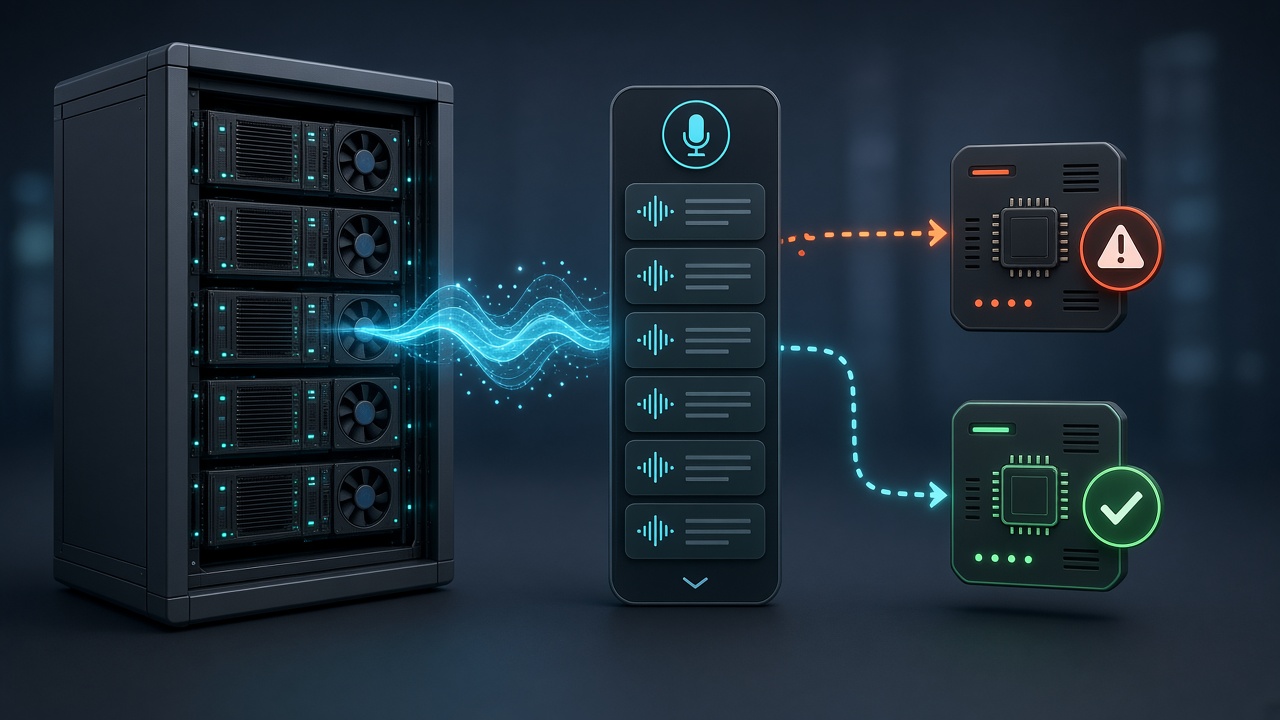
AssemblyAI reports 70 percent lower inference-compute costs than On-Demand pricing by running speech-to-text inference on GPU-backed Amazon ECS tasks and using a mix of Spot and On-Demand capacity. The part worth examining is not just the savings figure; it is the job-recovery design that lets the system use interruptible capacity without treating every interruption as a lost transcription.
Speech-to-text inference depends on recoverable jobs
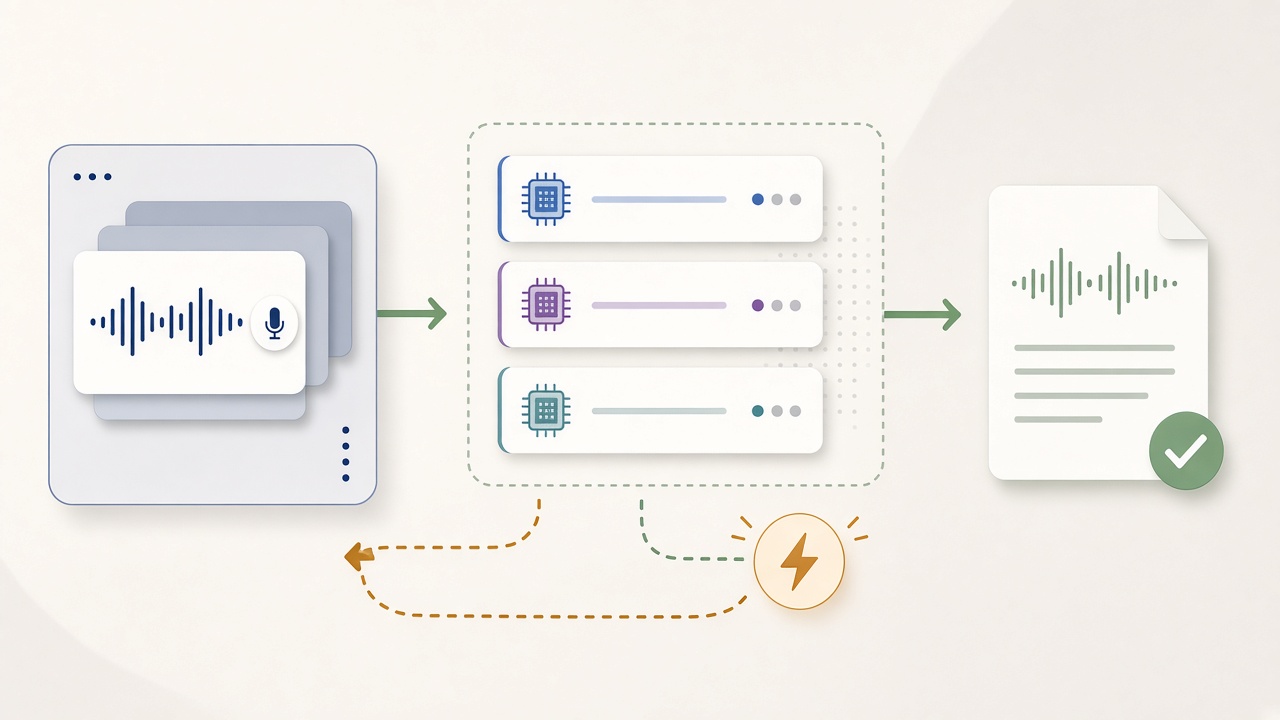
The architecture spreads Spot capacity across g4dn, g5, and g6 GPU instance families. That diversification gives the deployment more than one instance family to draw on, while On-Demand capacity provides another part of the mix. The source article says the system operates at a scale of thousands of instances, with compute demand nearly four times higher year over year.
Spot capacity can be reclaimed, so the system needs a way to handle work that was in flight when a task disappears. AssemblyAI uses Amazon SQS to return interrupted jobs to a queue, where another healthy task can complete them. That is the operational hinge: the queue makes interrupted compute a retryable event rather than an assumed failure of the whole job.
Worth a look
Phugialy Picks

ASUS TUF Gaming GeForce RTX 5070 12GB GDDR7 OC Edition Graphics Card

AI Engineering: Building Applications with Foundation Models
A practical guide to building real-world applications with foundation models and LLMs.

GMKtec K15 AI Mini PC Oculink Intel Ultra 5 125U 32GB DDR5 512GB SSD | Desktop Computer AI Boost, 3X M.2 2280 Storage Expansion, Dual NIC...
Some Phugialy Picks use affiliate links. If you buy through one, Phugialy may earn a commission. It doesn't change what we recommend. Full disclosure →
What the 70 percent saving depends on
The reported 70 percent saving is specifically against On-Demand pricing for inference compute. It is not a claim that the full service costs 70 percent less, or that every workload will see the same result. The distinction matters when deciding whether to copy the pattern: the source describes an architecture operating at substantial scale, not a universal benchmark for smaller deployments or different job types.
My read is that the most reusable idea is the pairing of cheaper, reclaimable capacity with explicit recovery. Spot by itself is not a cost strategy if interruptions leave work stranded or force a person to restart it. A queue-based retry path makes the trade-off more manageable, but the article’s savings figure does not tell us how much engineering effort went into that path or how often jobs need to be retried. Those are the details I would want before estimating savings for a production system.
Regional deployments make the design less one-size-fits-all
The article also describes independent regional deployments to support data residency requirements. That is useful context: a deployment is not simply one large pool of GPUs if data must stay within particular regions. Regional boundaries can shape where capacity is available, so the right practical question is whether the same mix of instance families and Spot capacity works for each deployment.
For a team considering this approach, I would first check that jobs can be safely requeued and completed by another task, then measure actual interruption and retry behavior in the regions that matter. The source supports the case for testing this pattern; it does not establish that every team should move inference to Spot. The deciding evidence is whether the compute savings hold up after recovery behavior and regional constraints are included.
Holiday picks
Thanksgiving: early shopping
Start early: products for hosting, travel and home, plus the gear you have been watching.

Monitors
Big purchaseLG 34WN80C-B UltraWide Monitor 34” 21:9 Curved WQHD (3440 x 1440) IPS Display, USB Type-C (60W PD), sRGB 99% Color Gamut, 3-Side Virtuall...
View on Amazon (opens in a new tab): LG 34WN80C-B UltraWide Monitor 34” 21:9 Curved WQHD (3440 x 1440) IPS Display, USB Type-C (60W PD), sRGB 99% Color Gamut, 3-Side Virtuall...Prices change daily. Check today's price on Amazon.
 New this week
Home & Kitchen
Keurig K-Elite Single Serve K-Cup Pod Coffee Maker, Brushed Silver
View on Amazon (opens in a new tab): Keurig K-Elite Single Serve K-Cup Pod Coffee Maker, Brushed SilverPrices change daily. Check today's price on Amazon.

Home & Kitchen
De'Longhi Magnifica Duo Automatic Espresso Machine, Milk Frother, Silver
View on Amazon (opens in a new tab): De'Longhi Magnifica Duo Automatic Espresso Machine, Milk Frother, SilverPrices change daily. Check today's price on Amazon.
We earn from qualifying purchases made through these links, at no extra cost to you, as an Amazon Associate and through other affiliate programs. Disclosure. See all Thanksgiving picks
Got a question about how this applies to you? →
Keep reading
Follow the thread

YouTube Copyright Claims Need a Clear Human Appeal Path
Media Nov Records says it runs 500 YouTube channels and sells automated copyright tools. In one reported case, a musician’s cover of a public-domain folk song was removed, and her counterclaims did not resolve the dispute.
Read this noteSame lane, different angle
Offline AI for Small Businesses: A Local Advantage
Fastagger is building AI around the constraints many products treat as edge cases: low-cost phones and unreliable internet. Auni’s integration into M-Pesa gives it a route to merchants, but sustained use—not sign-ups—will determine whether that distribution turns into a business.
Anthropic’s Multi-Chip Compute Strategy Has a Catch
Anthropic says Claude now runs across four major chip families, and that Mythos got it running on AMD in three days. The bigger claim is that software could make each unit of compute go further—but the roadshow does not yet quantify the commercial payoff.