Brooks’s Law for AI Agents Still Has a Coordination Cost
AI agents can reduce onboarding delays, but they do not make sequential work parallel. The harder production question is whether your team can review and integrate their output as quickly as agents produce it.
Automation needs a narrow first win
The best first AI workflow is usually a repeated task with a clear input, clear output, and a human approval step.
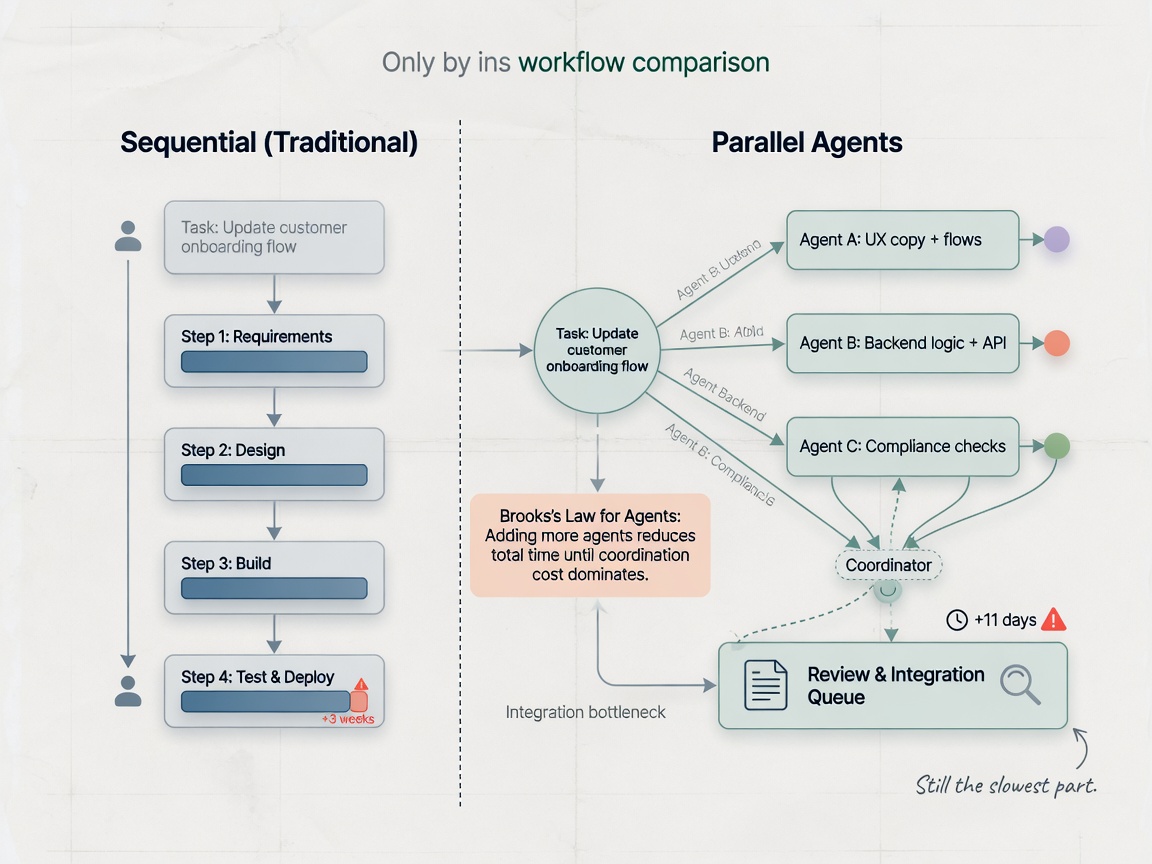
Brooks’s Law for AI agents is a useful warning: adding agents can speed up some work, but it does not make coordination overhead disappear. The source article argues that the bottleneck has shifted from coordinating people to orchestrating agents—not that the underlying constraints have gone away.
Brooks’s Law for AI agents still applies to sequential work
AI agents can reduce onboarding delays, but they cannot make a sequential task parallel. The article’s shorthand is that nine agents still can’t deliver a baby in one month. More workers do not shorten work that depends on an earlier step being finished first.
That matters when planning an agent workflow. Splitting a task into more assignments only helps when those pieces can genuinely proceed independently. If each agent needs the same decision, artifact, or result from another, the added capacity may just create more handoffs to manage.
Worth a look
Phugialy Picks

AI Engineering: Building Applications with Foundation Models
A practical guide to building real-world applications with foundation models and LLMs.

GMKtec K15 AI Mini PC Oculink Intel Ultra 5 125U 32GB DDR5 512GB SSD | Desktop Computer AI Boost, 3X M.2 2280 Storage Expansion, Dual NIC...

2084 and the AI Revolution, Updated and Expanded Edition: How Artificial Intelligence Informs Our Future
Some Phugialy Picks use affiliate links. If you buy through one, Phugialy may earn a commission. It doesn't change what we recommend. Full disclosure →
Code review and integration remain on the critical path
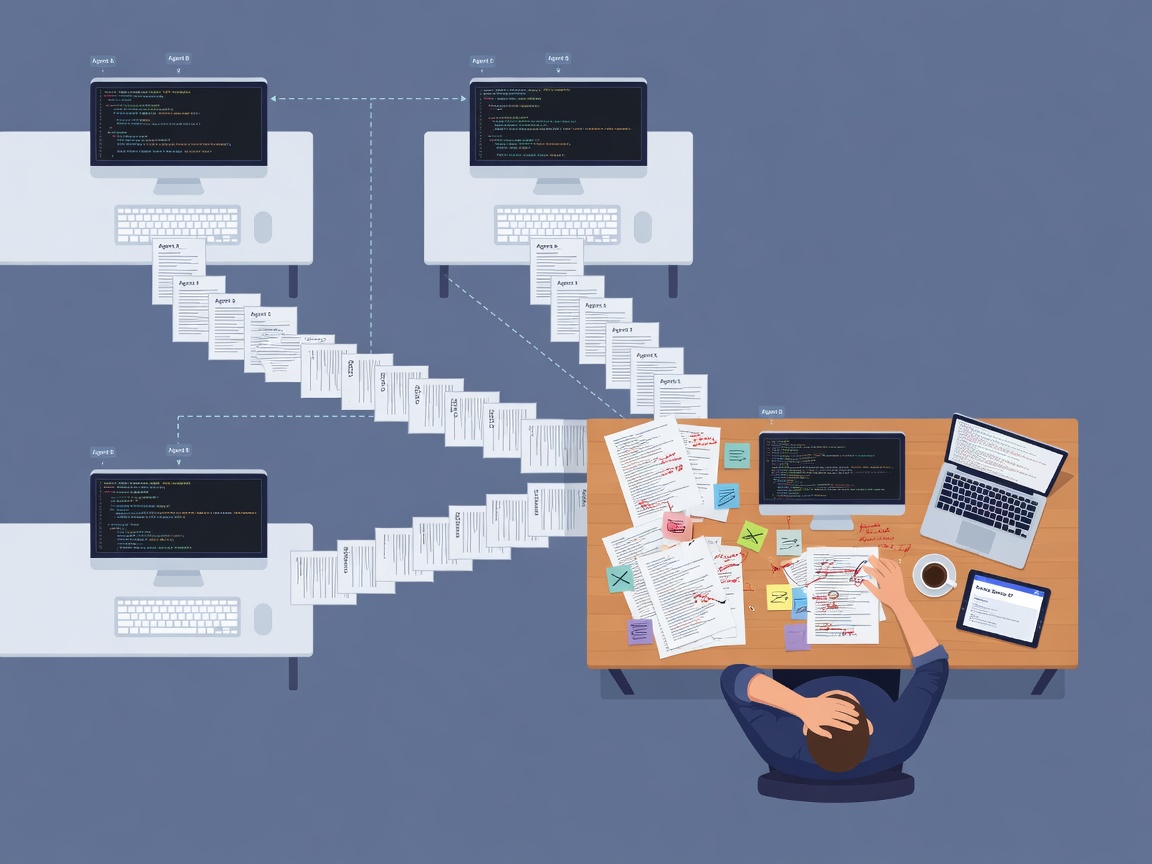
People still have to define what completion means, review code, catch hallucinations, and integrate agent contributions. Those responsibilities are not incidental cleanup; they are part of getting from generated output to a working result. Agents can produce contributions faster than a team can safely assess and combine them.
The integration risk gets concrete when agents work on the same codebase without clear orchestration: they may overwrite each other’s work. That is not a reason to avoid multi-agent setups. It is a reason to treat ownership and integration as design problems rather than assume parallel output will assemble itself.
My read is that review capacity is the limit worth measuring, not the number of agents you can start. A workflow that produces more code than anyone can check has increased throughput only on the output side. The useful question is whether the work arrives in pieces that can be reviewed and integrated without creating a new queue.
Add agents where the work can absorb them
The source article’s warning is direct: adding agents to a project with unclear requirements gets you the wrong answer faster. In practice, that means agent count is a poor proxy for progress. Clear completion criteria help people judge whether a contribution is usable; oversight is still needed to catch errors and make the pieces fit.
I’d add agents to work that can absorb parallel contributions, while keeping the human review and integration path visible. For a task with dependencies, unclear acceptance criteria, or shared files, adding more agents may move the bottleneck rather than remove it. The decision is not “agents or no agents”; it is whether the workflow has enough independent work to justify the extra coordination overhead.
A practical test: compare the time saved on parallel work with the time spent reviewing and integrating its output; if the latter grows faster, stop adding agents.
Got a question about how this applies to you? →
Keep reading
Follow the thread

Minecraft AI Agents: When Survival Rewrites the Plan
In a three-hour Minecraft run, 50 GPT-6.1 Sol agents formed a hierarchy and coordinated food delivery. Then 22 of the run’s 34 deaths happened during the first night—and the group started avoiding risk.
Read this noteSame lane, different angle
Generative AI for Information Is Growing, Not Agents
Generative AI is already a common route to information, but that does not mean people are ready to hand over tasks to agents or let AI write the news. The gap between those uses is the part product teams should pay attention to.
AI Training Data Needs Better Agent Evaluations
Handshake’s AI training business reportedly reached $1 billion in gross annualized revenue about a year after launch. Its benchmark demonstrations make the less comfortable point: a polished final answer can hide mistakes in how an agent handled the task.