AI-Assisted Signal Protocol Formal Verification in Practice
AI agents helped formally verify key security properties in Signal protocol code, with Lean checking the proofs. The work took four weeks, but covered just one percent of the codebase—making scope and specification the details worth examining next.

Automation needs a narrow first win
The best first AI workflow is usually a repeated task with a clear input, clear output, and a human approval step.
Signal protocol formal verification has now been demonstrated on production code behind a system used for billions of private conversations. Google DeepMind researchers used AlphaProof Code to prove key security properties of the Signal protocol implementation, generating more than six million lines of Lean in four weeks.
Signal Protocol Formal Verification Covers a Small Slice of Code
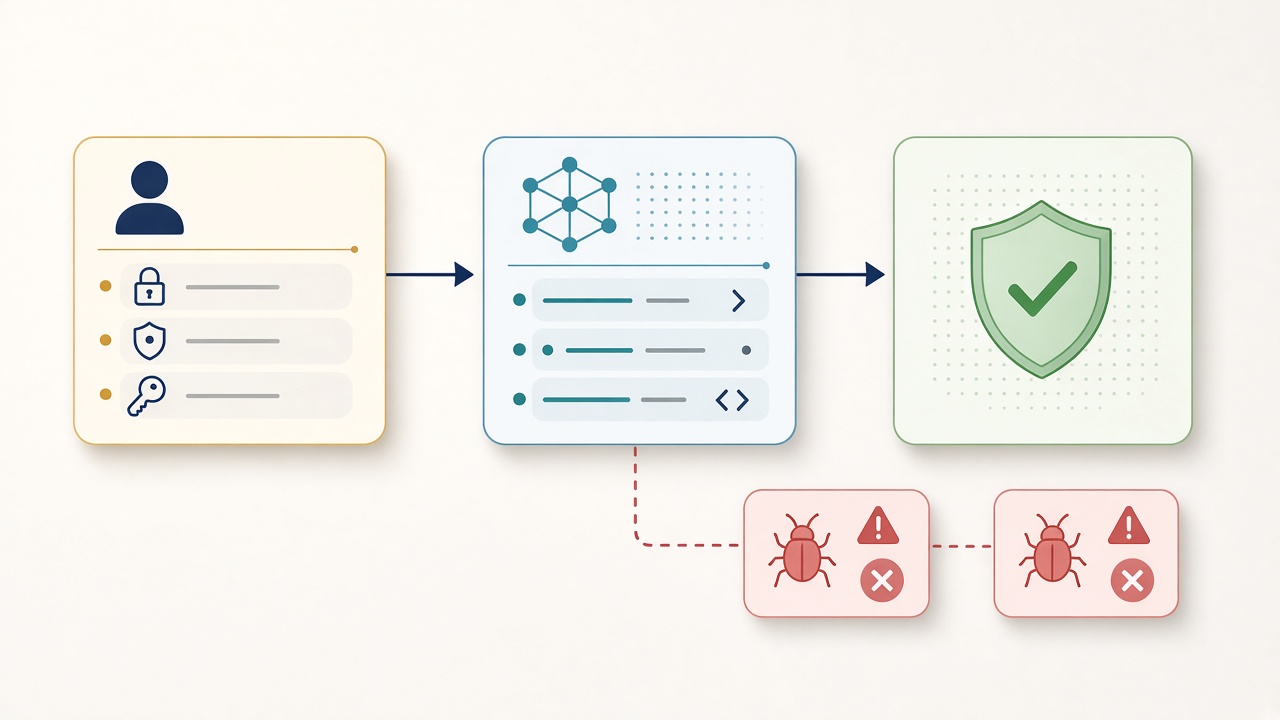
AlphaProof Code combines human experts with AI agents: people specify the security properties, and Gemini Carbon-powered agents generate proofs that Lean automatically checks. That division matters. The system is not simply asking an AI to inspect code and declare it safe; it is producing formal claims that a proof checker can validate.
The scope is the detail I would keep in view. The work covered just one percent of the codebase, according to the figures provided. The researchers describe this as the first formal verification of a widely deployed protocol implementation at this depth, and say a task that historically takes expert teams years took four weeks here. That is a striking change in the cost of attempting this kind of verification, but it is not evidence that the entire implementation has been proved secure.
For an integration team, the practical question is what properties were specified and how much of the code those properties cover. The source says the work proved key security properties, but does not provide those specifications or the proof artifacts themselves. The team plans to open-source the artifacts, which should make it possible to inspect the work rather than rely only on the headline numbers.
Worth a look
Phugialy Picks

AI Engineering: Building Applications with Foundation Models
A practical guide to building real-world applications with foundation models and LLMs.

GMKtec K15 AI Mini PC Oculink Intel Ultra 5 125U 32GB DDR5 512GB SSD | Desktop Computer AI Boost, 3X M.2 2280 Storage Expansion, Dual NIC...

2084 and the AI Revolution, Updated and Expanded Edition: How Artificial Intelligence Informs Our Future
Some Phugialy Picks use affiliate links. If you buy through one, Phugialy may earn a commission. It doesn't change what we recommend. Full disclosure →
Previously Fixed Bugs Became a Useful Test
The researchers also reintroduced two real, previously fixed bugs. AlphaProof Code produced machine-checked proofs that both buggy versions were insecure. That is a more useful demonstration than a clean-path proof alone: the system was able to distinguish the altered, insecure versions against the properties being checked.
Still, this is a bounded test, not evidence that the framework will catch arbitrary bugs in unfamiliar code. My read is that the result is strongest as a workflow demonstration: experts define what must hold, agents help construct proofs, and Lean checks them. The human specification work remains part of the system, and the available summary does not establish how much effort it took to define or refine those properties.
The Next Test Is Reusable Proof Work
The important production question is whether this process can expand beyond a carefully selected slice without making specification and maintenance the new bottleneck. Six million lines of Lean is a substantial proof output, but line count alone does not tell us how easy the artifacts are to review, update, or apply to other code.
I would treat AlphaProof Code as a credible reason to test formal verification on security-critical components, not as a shortcut to declaring a protocol secure. When the planned artifacts are available, the useful things to inspect are the stated properties, the covered code, and how the two buggy versions are represented. Those details will show whether the four-week result is a repeatable engineering method or an unusually well-supported research case.
Holiday picks
Thanksgiving: early shopping
Start early: products for hosting, travel and home, plus the gear you have been watching.

Monitors
Big purchaseLG 34WN80C-B UltraWide Monitor 34” 21:9 Curved WQHD (3440 x 1440) IPS Display, USB Type-C (60W PD), sRGB 99% Color Gamut, 3-Side Virtuall...
View on Amazon (opens in a new tab): LG 34WN80C-B UltraWide Monitor 34” 21:9 Curved WQHD (3440 x 1440) IPS Display, USB Type-C (60W PD), sRGB 99% Color Gamut, 3-Side Virtuall...Prices change daily. Check today's price on Amazon.
 New this week
Home & Kitchen
Keurig K-Elite Single Serve K-Cup Pod Coffee Maker, Brushed Silver
View on Amazon (opens in a new tab): Keurig K-Elite Single Serve K-Cup Pod Coffee Maker, Brushed SilverPrices change daily. Check today's price on Amazon.

Home & Kitchen
eufy C28 Robot Vacuum Cleaner and Mop for pet hair, 15,000 Pa
View on Amazon (opens in a new tab): eufy C28 Robot Vacuum Cleaner and Mop for pet hair, 15,000 PaPrices change daily. Check today's price on Amazon.
We earn from qualifying purchases made through these links, at no extra cost to you, as an Amazon Associate and through other affiliate programs. Disclosure. See all Thanksgiving picks
Got a question about how this applies to you? →
For a related look at AI-generated proofs, see “Formally Verifying 3D Mesh Intersections with AI-Generated Proofs.”
Keep reading
Follow the thread

YouTube Copyright Claims Need a Clear Human Appeal Path
Media Nov Records says it runs 500 YouTube channels and sells automated copyright tools. In one reported case, a musician’s cover of a public-domain folk song was removed, and her counterclaims did not resolve the dispute.
Read this noteSame lane, different angle
Speech-to-Text Inference Cuts Compute Costs With Spot
AssemblyAI reports 70 percent lower inference-compute costs than On-Demand pricing. The useful part to study is how Amazon SQS turns Spot interruptions into recoverable jobs—and what to measure before expecting the same savings.
Offline AI for Small Businesses: A Local Advantage
Fastagger is building AI around the constraints many products treat as edge cases: low-cost phones and unreliable internet. Auni’s integration into M-Pesa gives it a route to merchants, but sustained use—not sign-ups—will determine whether that distribution turns into a business.