ERC-8004 in Practice: Most AI Agent Trust Data Fails Audit
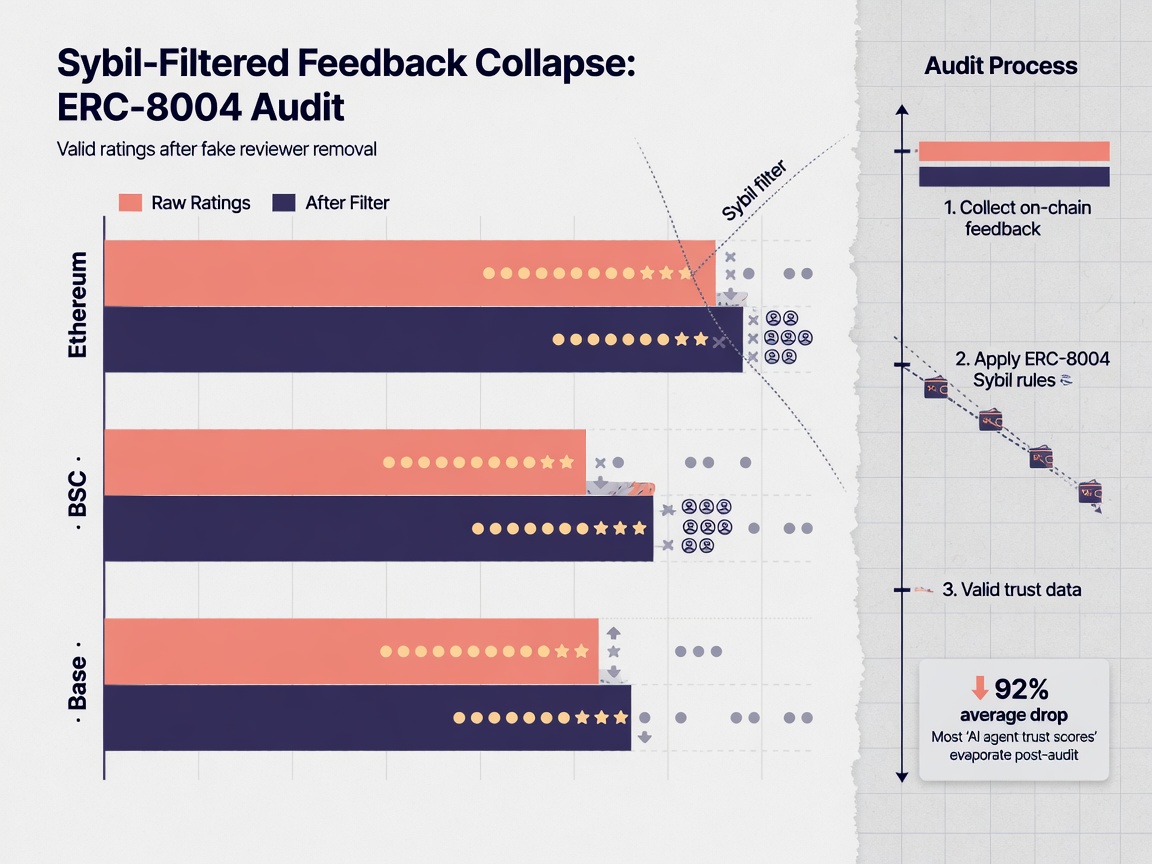
Only 3% of ERC-8004 identity registrations on Ethereum expose valid registration files - and after removing Sybil-flagged feedback, most rated AI agents have no valid feedback left at all.

Automation needs a narrow first win
The best first AI workflow is usually a repeated task with a clear input, clear output, and a human approval step.
If your business is planning to transact with autonomous AI agents and you were counting on ERC-8004 to tell you who to trust, the first empirical study of the protocol has bad news: only 3% of identity registrations on Ethereum, 4% on BNB Smart Chain, and 15% on Base expose valid registration files. The rest are placeholders - entries sitting in a registry with nothing behind them.
What The Numbers Actually Show
The study examines the ERC-8004 protocol, a permissionless trust layer for AI agent economies built on three on-chain registries, across Ethereum, BNB Smart Chain, and Base from deployment through May 13, 2026. The picture it paints is of infrastructure that exists on paper but not in practice.
The identity problem is the milder one. Most registrations are placeholders rather than active agents - meaning anyone scanning these registries today can't tell which entries correspond to real, functioning agents. That's a data-quality problem with a known fix: validate registration files before treating an entry as real.
The reputation problem is harder. The study finds the reputation registry cannot function as a trust signal at all, for two reasons: feedback values are incommensurable (you can't meaningfully compare one agent's rating against another's), and the feedback itself is manipulable. A substantial fraction of reviewers exhibit coordinated Sybil behavior across all three chains - meaning fake or coordinated accounts are inflating or gaming ratings.
And here's the number that should end any near-term plan to rely on this: after removing Sybil-flagged feedback, most rated agents are left with no valid feedback at all. The Sybil share runs from 15.8% of reviewers on Ethereum to 77.9% on BSC and 86.8% on Base.
Worth a look
Phugialy Picks

AI Engineering: Building Applications with Foundation Models
A practical guide to building real-world applications with foundation models and LLMs.

GMKtec K15 AI Mini PC Oculink Intel Ultra 5 125U 32GB DDR5 512GB SSD | Desktop Computer AI Boost, 3X M.2 2280 Storage Expansion, Dual NIC...

AI: Understand the Revolution: From Basics and Buzzwords to Tech Giants, Governments, and Your Future
Some Phugialy Picks use affiliate links. If you buy through one, Phugialy may earn a commission. It doesn't change what we recommend. Full disclosure →
What This Means For Adoption Decisions
For a team evaluating agent-to-agent commerce, the practical read is straightforward: there is currently no reliable, permissionless trust layer you can outsource your counterparty vetting to. If a vendor pitches you an agent marketplace built "on ERC-8004 trust scores," ask what happens after Sybil filtering - because per this data, most of those scores dissolve.
That doesn't make the protocol worthless; it makes it early. The study explicitly yields actionable protocol-design implications for future revisions of ERC-8004 - which tells you the authors see this as a fixable design-stage failure, not a dead end. Identity registries are cheap to harden. Reputation systems with incommensurable values are a deeper redesign.
My read (interpretation, not fact): the real cost here isn't adopting ERC-8004 - it's the operational burden that stays with you if you do. Until reputation data survives manipulation filtering, any business transacting across organizational boundaries still has to run its own vetting: contract terms, escrow, staged commitments, human review for high-value transactions. Budget for that as if the trust layer doesn't exist yet, because functionally it doesn't.
Who Should Actually Care Right Now
The businesses this most affects aren't the ones buying AI agents today - they're the ones building marketplaces or platforms where third-party agents will transact under their brand. They inherit the trust problem directly. Everyone else can wait this out at near-zero cost.
Worth adopting once concrete conditions hold: valid-feedback rates that survive Sybil filtering at meaningful percentages per chain (not single digits), and a reputation schema whose values are actually comparable across agents. Until then, treat these registries as directories at best - useful for discovery, useless as a trust signal.
Got a question about how this applies to you? →
Keep reading
Follow the thread

Why Most Enterprise AI Agents Never Reach Production
Two out of three enterprise AI agents never reach production — and the reason isn't model quality. It's that the agent doesn't know what your data means.
Read this noteSame lane, different angle
Automated PoC Generation Fixes AI Bug Reports
AnyPoC turns LLM bug reports into executable proof-of-concept tests — rejecting 9.7x more false positives than naive validation. The architecture behind why one agent grading its own homework fails.
Multi-Agent AI Systems Are Taking Over Supply Chain Execution
Multi-agent AI systems just replaced human approval stages at Lenovo across 180 markets - but the interesting part isn't the speed gains. It's what every deployment that actually shipped did before turning the agents loose.