Cerebellum-Inspired Memtransistor: Why AI Needs to Stop Thinking
# Cerebellum-Inspired Memtransistor: Why AI Needs to Stop Thinking Northwestern researchers have cracked a code that might finally solve AI's biggest problem: energy waste. Their cerebellum-inspired memtransistor doesn'
Automation needs a narrow first win
The best first AI workflow is usually a repeated task with a clear input, clear output, and a human approval step.
Cerebellum-Inspired Memtransistor: Why AI Needs to Stop Thinking
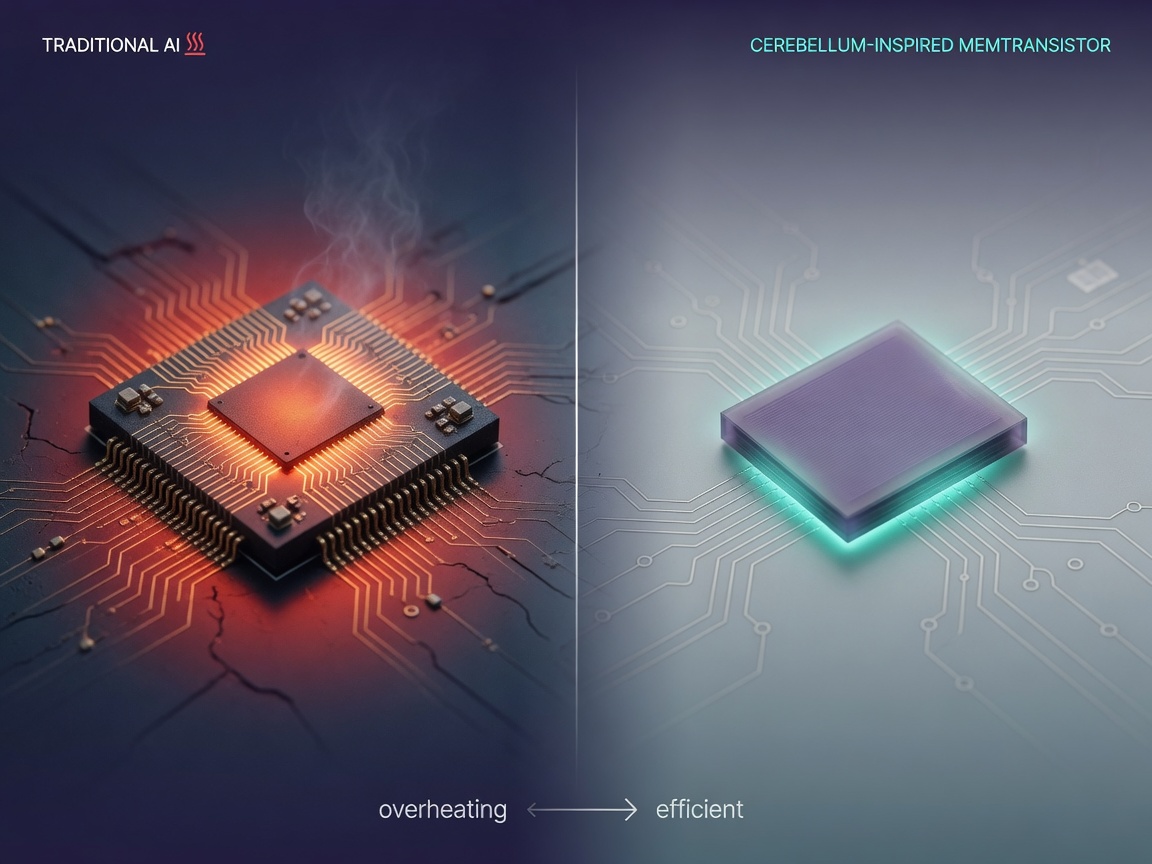
Northwestern researchers have cracked a code that might finally solve AI's biggest problem: energy waste. Their cerebellum-inspired memtransistor doesn't just mimic brain reflexes—it actually ignores the expected and reserves its power for the unexpected, like detecting an irregular heartbeat before it even ends.
The Core Innovation
Instead of processing every data point, this device uses molybdenum disulfide with an asymmetric transistor architecture to switch between excitatory and inhibitory modes. It's a simple concept: ignore routine information while immediately flagging unexpected events like abnormal heart rhythms.
Why This Matters for Hardware
The performance numbers are staggering. The system achieves 98 percent accuracy in identifying abnormal heart rhythms, with detection happening within one-fifth of a heartbeat. In the 2023 study, it showed roughly a 100-fold energy consumption reduction and is more than twice as fast as conventional AI.
The Real Shift
Today's AI is remarkably good at recognizing patterns, but it often spends enormous amounts of computing power to continuously analyze streams of data—even when nothing has changed. Our cerebellum-inspired memtransistor detected an irregular heartbeat within a fraction of a second, before the heartbeat even ended.
We intend to continue going down this path to mimic more and more of this complicated system. Researchers plan to explore mimicking cerebellum's ability to learn and adapt over time.
The Bottom Line
This isn't just about saving energy; it's about rethinking how AI operates at the hardware level. If you're building wearables or autonomous systems, this is a game-changer.
Worth a look
Phugialy Picks

GMKtec K15 AI Mini PC Oculink Intel Ultra 5 125U 32GB DDR5 512GB SSD | Desktop Computer AI Boost, 3X M.2 2280 Storage Expansion, Dual NIC...

GEEKOM IT15 AI Mini PC, Intel Ultra 9 285H(99 Tops), 32GB DDR5, 1TB SSD | The Most Powerful Workstation,Arc 140T GPU,WiFi 7,8K Business D...

GMKtec EVO-T2S Mini PC AI Ultra X7 Processor 358H 64GB LPDDR5X 8533 MT/S | Gaming Mini Computer Arc B390 1TB PCIe 5.0 SSD Oculink, WiFi 7...
Some Phugialy Picks use affiliate links. If you buy through one, Phugialy may earn a commission. It doesn't change what we recommend. Full disclosure →
Got a question about how this applies to you? →
Keep reading
Follow the thread

AI Hardware Revolution: From $999 Mini PCs to Desktop Supercomputers
The draft was strong but drifted from the 'Enthusiast' persona by being too informative and slightly critical. I boosted energy and humor, removed hedging phrases like 'approximately', and tightened the structure for better flow. The image plan remains unchanged as the content now supports it well.
Read this noteSame lane, different angle
AI Tutors Work Only If Students Use Them: Trial
A two-year trial across 18 middle schools found Khan Academy's AI tutor raised math scores modestly - but here's the catch: the gains looked just like those from practice without any AI at all. The real story isn't whether AI tutoring works; it's that 96% of students tried it and almost none used it when they actually needed help.
Spectral Attacks Reveal a Hidden Weak Spot in Vision-Language Models
Researchers found a way to attack vision-language models using the model's own internal geometry — aligning representations with the subspaces the model cares about least. It beats existing baselines, and the same insight could make these models tougher.