AWS GraphRAG Deployment Cuts Drug Research Cycles by 87% — Here's How It Works
# AWS GraphRAG Deployment Cuts Drug Research Cycles by 87% — Here's How It Works Historically, initial data gathering and screening phases in pharmaceutical R&D took over six months per iteration with a low five percent

Automation needs a narrow first win
The best first AI workflow is usually a repeated task with a clear input, clear output, and a human approval step.
AWS GraphRAG Deployment Cuts Drug Research Cycles by 87% — Here's How It Works
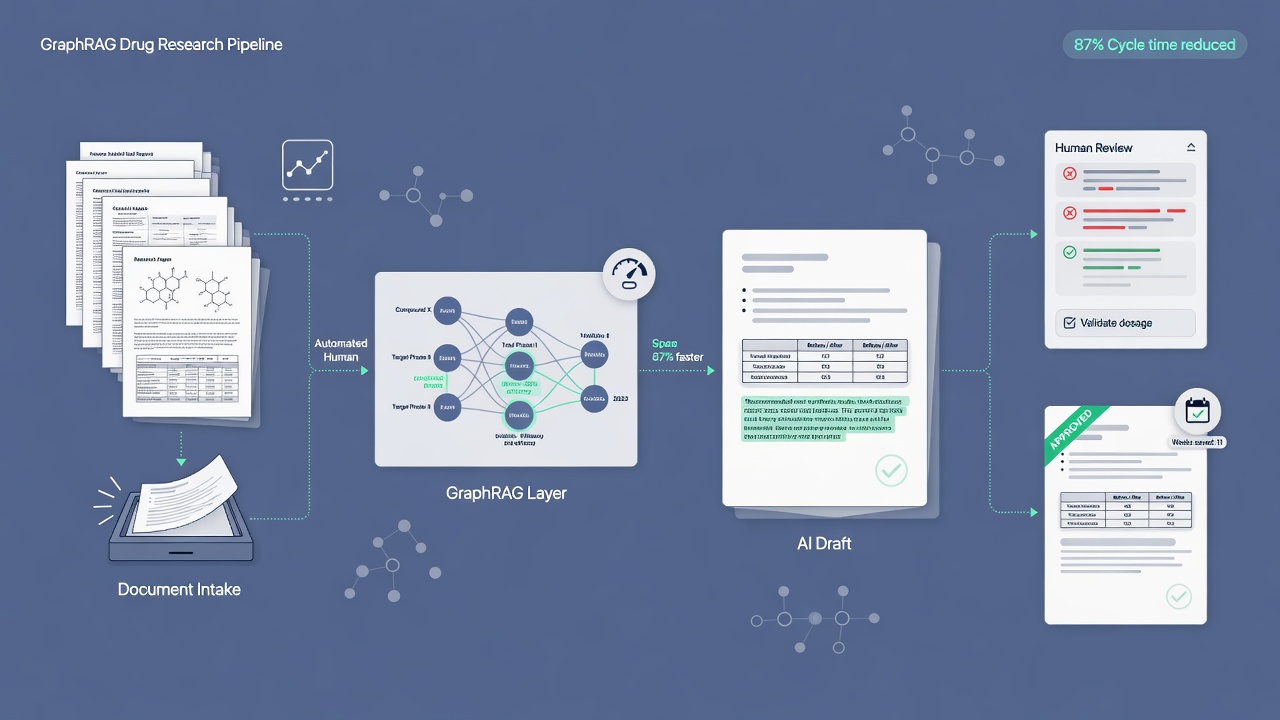
Historically, initial data gathering and screening phases in pharmaceutical R&D took over six months per iteration with a low five percent success rate. A recent deployment of AWS GraphRAG reduced drug research and development cycles in pharmaceutical environments by 87 percent.
The acceleration is achieved by integrating previously separated proprietary databases into a unified and queryable knowledge graph. This setup relies on a GraphRAG framework and uses Amazon Neptune Analytics and Bedrock to turn disconnected data points into a searchable network.
Users can submit standard natural language queries and receive answers mapped to verified domain literature and internal datasets. The solution combines graph databases with NLP to turn disconnected data points into a searchable network, enabling natural language queries mapped to verified domain literature.
How the Architecture Pulls It Together
The system pulls in messy, unstructured files from public databases like PubMed and mixes them with internal corporate records. Tools like Amazon Comprehend Medical scan this text to pull out standard medical codes.
Amazon Bedrock summarises the document contents and determines topical relevance. AWS Lambda functions and Amazon S3 bulk loads then route these processed elements into Amazon Neptune Analytics.
The resulting knowledge graph structures the data into discrete nodes representing core entities like domain-specific classes, authors, source journals, and embedded text chunks. The graph edges define the relationships between these nodes, mapping out hierarchical classifications and entity associations.
Worth a look
Phugialy Picks

LG 34WN80C-B UltraWide Monitor 34” 21:9 Curved WQHD (3440 x 1440) IPS Display, USB Type-C (60W PD), sRGB 99% Color Gamut, 3-Side Virtuall...

LLM Systems Engineering: Training and Building Large Language Models – Engineering AI Models Through Fine-Tuning, Continued Pretraining, and From-Scratch Development (AI Engineering)

Anker USB-C to USB-C 60W Fast Charging Cable (2-Pack)
We'd buy this if: You need a reliable spare charging cable that won't fray in a month.
We'd skip this if: You already have enough cables lying around.
Some Phugialy Picks use affiliate links. If you buy through one, Phugialy may earn a commission. It doesn't change what we recommend. Full disclosure →
Entity Linking and Accuracy
A dedicated Knowledge Graph Linker processes incoming natural language queries, extracts relevant entities using fuzzy string indexing, and maps them to established graph nodes. The system traverses the network pathways to generate plausible relational links before drafting a response through the Bedrock-hosted language model.
Retrieval accuracy depends on the entity matching configuration. An EntityLinker component aligns natural language terms from user prompts to the structured data schema. This fuzzy matching process handles the inherent noise and varied terminology found in complex enterprise datasets, ensuring users retrieve the correct nodes even when using imprecise language.
Performance Metrics
Active deployments of the Neptune and Bedrock architecture return exact, verifiable citations for every generated answer. Initial discovery phases that previously required six months now conclude in three weeks. Data retrieval speeds show an 85 percent improvement, directly supporting faster hypothesis testing.
Research review times drop by 70 percent due to automated citation mapping and source verification features. A standard Amazon Neptune Analytics graph running with 16 provisioned memory units incurs operational costs of $0.48 per hour.
Compliance and Traceability
Engineering teams can integrate new public databases or internal notes into the existing graph structure without disrupting active query interfaces. Teams can trace every output directly to source documents, fulfilling compliance requirements for scientific integrity.
The system maps the entire reasoning path, displaying the specific graph traversal steps used to reach a conclusion. When senior scientists resign, their tacit knowledge regarding system behaviours or failed experiments remains indexed within the Neptune database.
Recommendations for Implementation
Strict schema governance is required to prevent inaccurate relational mapping and mitigate the risk of hallucinations. Because the system is modular, teams can swap out the language model or tweak the graph structure without having to tear down and rebuild the whole app.
For governance and compliance, exact evidence trails required for regulatory submissions are captured, with graph traversal visualisations proving precisely how an AI model connected complex variables. Maintaining a centralised knowledge graph stops data decay.
Got a question about how this applies to you? →
Keep reading
Follow the thread
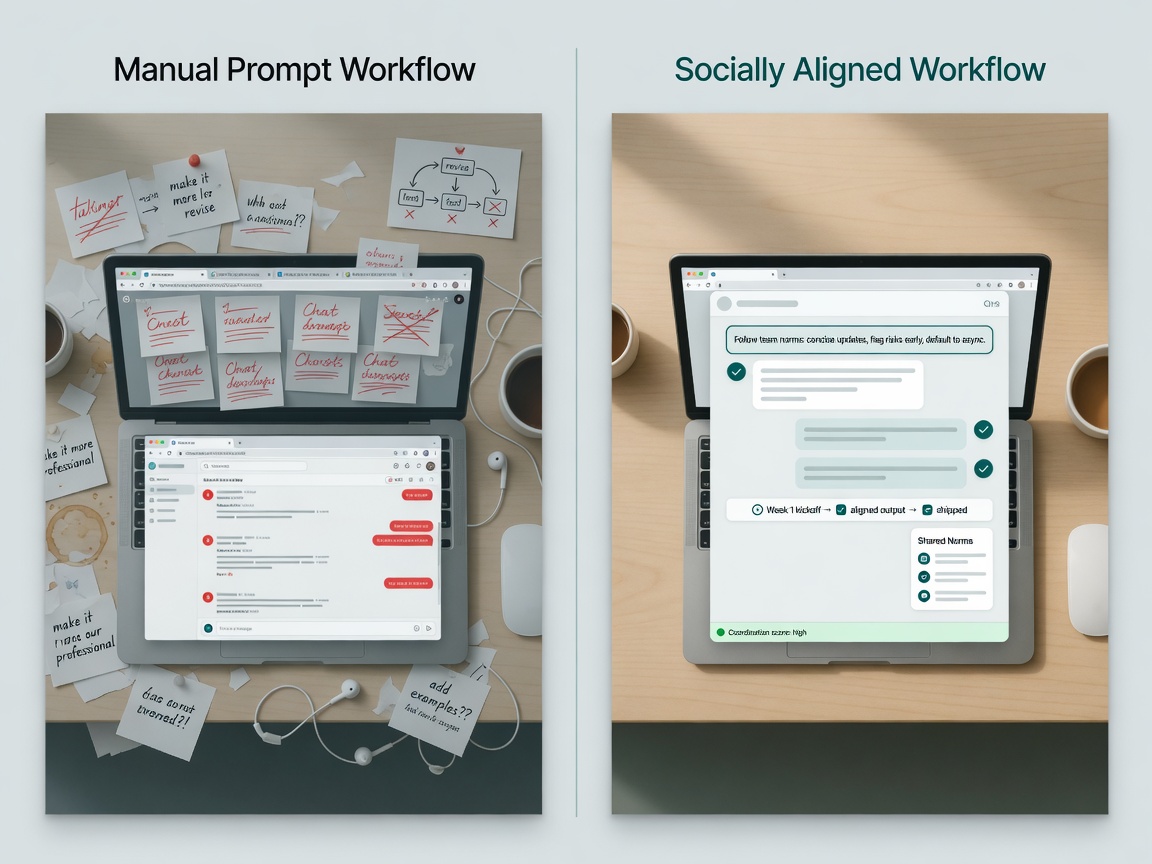
How Social Norms Improve Human-AI Coordination
New research shows that AI agents informed by social norms can outperform human-human interactions by 43%. This suggests the next leap in coordination isn't better data, but better alignment with human social principles.
Read this noteSame lane, different angle
The OPTICS Benchmark Shows VLMs Still Can't Count
State-of-the-art vision-language models score below 40% on counting tasks in zero-shot settings — and even newer reasoning models trail humans by 20%. A new benchmark called OPTICS breaks down exactly where visual reasoning falls apart.
How AI Labs Are Becoming a Counterbalance to Government
Frontier AI labs are transitioning from mere software providers to critical infrastructure, creating a scenario where they may soon act as a counterbalance to government. As AI becomes the primary substrate for cognitive