AI Scraping Bots Put Academic Library Access at Risk
AI companies support a shared robots.txt opt-out signal, but the bots causing the most visible disruption may not be covered. For libraries, openness can become a service problem when automated demand makes collections unreachable.

Automation needs a narrow first win
The best first AI workflow is usually a repeated task with a clear input, clear output, and a human approval step.
AI scraping bots are disrupting academic library access, but support for a shared robots.txt signal is not the same as a solution. The reported problem is not simply that AI companies collect material; it is that some bots make public collections difficult or impossible to reach while doing so.
AI scraping bots turn collection access into an infrastructure issue
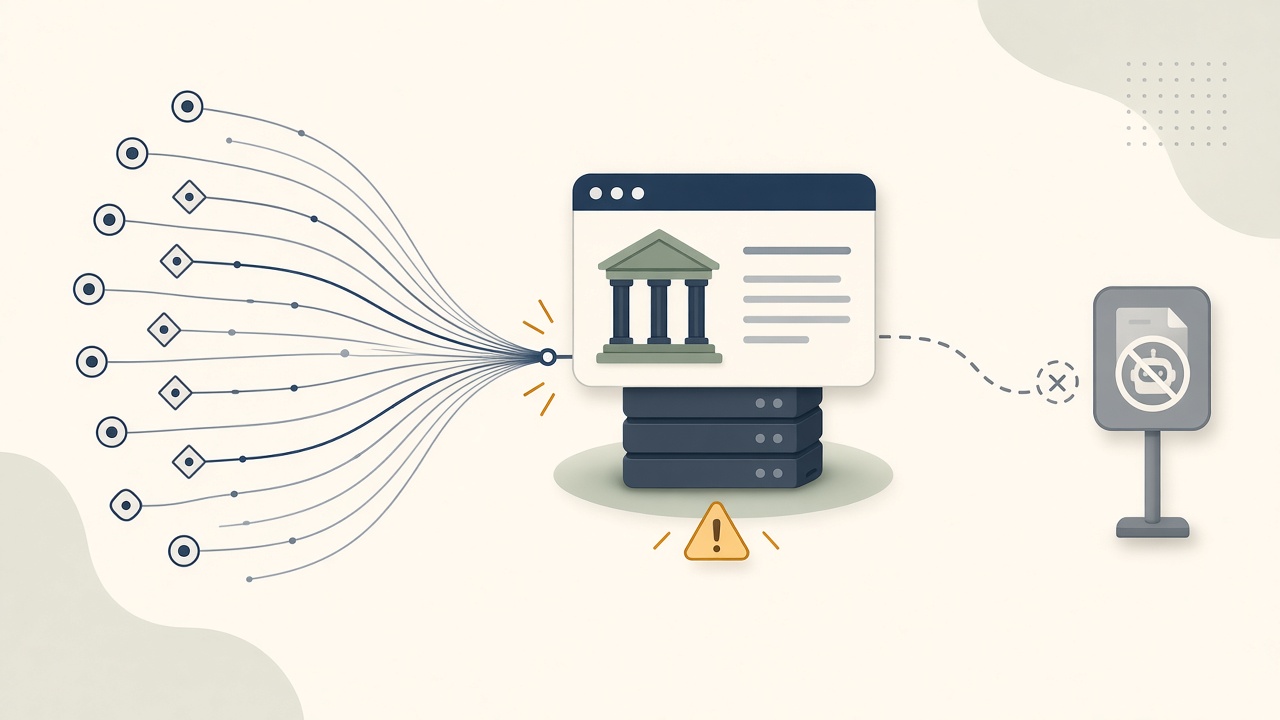
Academic libraries and cultural institutions are reporting bots that send excessive requests, slowing websites or taking them offline as they gather material for large language models. Some bots ignore robots.txt instructions and can request thousands of documents a second. Blocking their IP addresses is less effective when operators distribute requests across many addresses.
That changes the practical question. A collection can be legally and intentionally open while its website is still unavailable to readers. Project Gutenberg, for example, welcomes its public-domain books being used for AI training, but says bots should access them without taking the site down. The distinction matters: openness to reuse is not consent to a level of automated demand that interrupts ordinary access.
Worth a look
Phugialy Picks

AI Engineering: Building Applications with Foundation Models
A practical guide to building real-world applications with foundation models and LLMs.

GMKtec K15 AI Mini PC Oculink Intel Ultra 5 125U 32GB DDR5 512GB SSD | Desktop Computer AI Boost, 3X M.2 2280 Storage Expansion, Dual NIC...

2084 and the AI Revolution, Updated and Expanded Edition: How Artificial Intelligence Informs Our Future
Some Phugialy Picks use affiliate links. If you buy through one, Phugialy may earn a commission. It doesn't change what we recommend. Full disclosure →
The examples show disruption, not a universal measure of scale
The source article describes more than 11,000 searches for Finnish music on one day, coming from thousands of different internet addresses, and reports bots requesting thousands of documents a second. Those examples make the operational burden concrete, but they do not establish how often this happens across all institutions or how much traffic any one bot operator generates over time.
That limit should temper broad conclusions without minimizing the problem. A small number of extreme request patterns can still disrupt a public resource; the figures are evidence of a real access failure, not a complete census of AI scraping. The relevant measure for a library is not only how much material gets copied, but whether people can still use the collection while copying is underway.
A robots.txt opt-out signal leaves enforcement unresolved
Anthropic, OpenAI, Google and Microsoft have expressed support for a standardized robots.txt opt-out signal. But the signal would be voluntary, and the proposal excludes some third-party and smaller-company bots. It therefore offers a way for participating operators to recognize a preference, not a general mechanism to ensure that every scraper respects it.
The gap matters because the hardest cases described here are bots that ignore instructions and spread requests across addresses. Meanwhile, CAPTCHA and login requirements can block helpful bots or create barriers for people. Institutions face a constrained choice: allow broad access and risk disruption, or add controls that may make legitimate use harder.
The narrower claim that survives is that standardized opt-out signals could help where operators choose to honor them; they do not, on the evidence described, guarantee reliable access to library collections. Until coverage and compliance extend beyond willing major firms, the burden of keeping open collections usable remains with the institutions hosting them.
Got a question about how this applies to you? →
Keep reading
Follow the thread

NVIDIA’s Robotics Simulation Stack Faces the Transfer Test
GR00T 2 reached 40 of 50 tasks without task-specific demonstrations, and its reported success rose to 95% with five demonstrations per task. The harder question is whether these results transfer beyond the evaluation setup—and NVIDIA’s simulation stack is where that question can be tested at greater scale.
Read this noteSame lane, different angle
AI Coding and the Cost of a Fragile SaaS Codebase
AI coding can speed up pull requests while leaving the tests shallow and the code harder to understand. The deciding question is not how much code it generates, but whether your team can still verify and maintain it.
Federal AI Regulation: Risk Claims Need a Testable Line
Scott Wiener wants Congress to act on catastrophic AI risks, including recursive self-improvement. The hard part is translating that warning into rules with clear triggers, tests, and accountability.