Agentic AI for Financial Services: Duco’s Stack
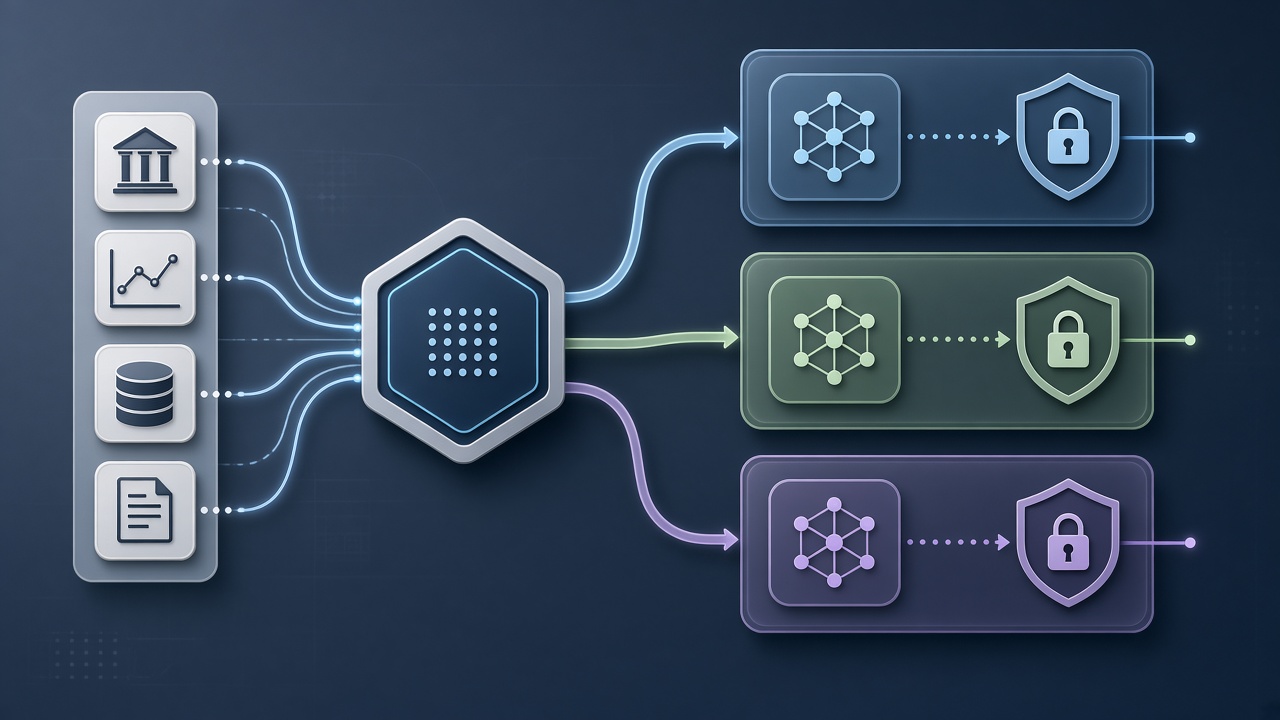
Duco’s agentic AI for financial services stack pairs Amazon Bedrock’s foundation-model access with Amazon Bedrock AgentCore’s managed agent runtime. The useful change is not just adding agents: Duco can select models fro
Automation needs a narrow first win
The best first AI workflow is usually a repeated task with a clear input, clear output, and a human approval step.
Duco’s agentic AI for financial services stack pairs Amazon Bedrock’s foundation-model access with Amazon Bedrock AgentCore’s managed agent runtime. The useful change is not just adding agents: Duco can select models from multiple providers through one API while keeping tenant-specific runtimes, gateways, authentication, and data infrastructure isolated.
Agentic AI for financial services needs more than model choice
Duco says its traditional machine-learning models were not agile or flexible enough to find new problems or take the next step beyond what they had learned. Its new approach uses Amazon Bedrock to access foundation models and AgentCore to run agents at scale. Duco can switch models by changing a configuration parameter, rather than changing the API it uses to access them.
That flexibility is useful when a team wants to evaluate different providers without rebuilding its integration each time. But a configuration switch is not evidence that models are interchangeable in quality, cost, or behavior. The source does not provide comparative results on those dimensions. My read: the practical benefit is a cleaner way to make model choice adjustable; the work of validating each model for a financial workflow still remains.
AgentCore also supports Duco’s existing LangChain and LangGraph code and provides a managed runtime. That matters at integration time: teams can keep using those frameworks while moving agent execution onto managed infrastructure. It narrows the gap between an agent prototype and a service intended to run at scale, though the source does not give operational benchmarks for the runtime.
Worth a look
Phugialy Picks

AI Engineering: Building Applications with Foundation Models
A practical guide to building real-world applications with foundation models and LLMs.

GMKtec K15 AI Mini PC Oculink Intel Ultra 5 125U 32GB DDR5 512GB SSD | Desktop Computer AI Boost, 3X M.2 2280 Storage Expansion, Dual NIC...

2084 and the AI Revolution, Updated and Expanded Edition: How Artificial Intelligence Informs Our Future
Some Phugialy Picks use affiliate links. If you buy through one, Phugialy may earn a commission. It doesn't change what we recommend. Full disclosure →
Tenant isolation is the production detail to inspect
Duco’s architecture assigns dedicated agent runtimes and gateways to each tenant, with tenant-scoped authentication and isolated data infrastructure. For financial institutions, this is not a footnote to the model story; it is part of the architecture being described. A shared model API does not mean shared tenant data or a shared agent runtime in Duco’s design.
The scale figures make that design consequential, but they need careful reading: Duco reports handling 20 billion transactions monthly and serving 200+ clients, including 7 of the top 20 banks and 10 of the top 20 asset managers, across more than 20,000 processes. Those numbers describe Duco’s platform and customer footprint; they do not establish that agents handle every transaction or process.
My practical takeaway is to look past the model-selection demo and inspect the boundaries: how tenant identity is carried into each agent run, and how access stays scoped across the runtime, gateway, and data layer. The source outlines Duco’s isolation approach, but does not report failure cases or independent validation. For a build decision, I’d want those details before treating the architecture as proven under every edge case. The model API is the easy part to swap; the isolation model is what I’d want to understand before shipping.
Holiday picks
Thanksgiving: early shopping
Start early: products for hosting, travel and home, plus the gear you have been watching.

Audio
Big purchaseSony WH-1000XM5 Premium Noise Cancelling Wireless Headphones
View on Amazon (opens in a new tab): Sony WH-1000XM5 Premium Noise Cancelling Wireless HeadphonesPrices change daily. Check today's price on Amazon.

Home & Kitchen
eufy C28 Robot Vacuum Cleaner and Mop for pet hair, 15,000 Pa
View on Amazon (opens in a new tab): eufy C28 Robot Vacuum Cleaner and Mop for pet hair, 15,000 PaPrices change daily. Check today's price on Amazon.
 New this week
Home & Kitchen
Keurig K-Elite Single Serve K-Cup Pod Coffee Maker, Brushed Silver
View on Amazon (opens in a new tab): Keurig K-Elite Single Serve K-Cup Pod Coffee Maker, Brushed SilverPrices change daily. Check today's price on Amazon.
We earn from qualifying purchases made through these links, at no extra cost to you, as an Amazon Associate and through other affiliate programs. Disclosure. See all Thanksgiving picks
Got a question about how this applies to you? →
Keep reading
Follow the thread

AI Loan Servicing Assistant: Where the Work Really Is
LoanPro’s assistant works across eight API endpoints and synthesizes around 1,400 fields per account. The reported call-time reduction is up to 15 percent, but the more useful question for builders is how each stage handles messy account data.
Read this noteSame lane, different angle
Agentic AI for Lab Operations Depends on Better Data
SWARM reports roughly 130 times faster first responses and 96.2 percent automated ticket coverage. The more useful engineering lesson may be less about adding agents and more about building the equipment-specific document pipeline that helps them retrieve the right knowledge.
Autonomous Security Operations: What Greenlight Shows
Greenlight says its AI system resolves more than 90 percent of security and risk cases. The architecture behind that figure includes escalation, memory, and a feedback pipeline—but the rate alone does not show whether the hardest mistakes are being caught.