The Reasoning Paradox: Why Smarter LLMs Are Faster at Stereotyping
The research from Princeton and the University of Chicago reveals a problematic trend in LLM development: models aren't just mirroring the biases of their training sets; they are actively learning new ones through experi

Automation needs a narrow first win
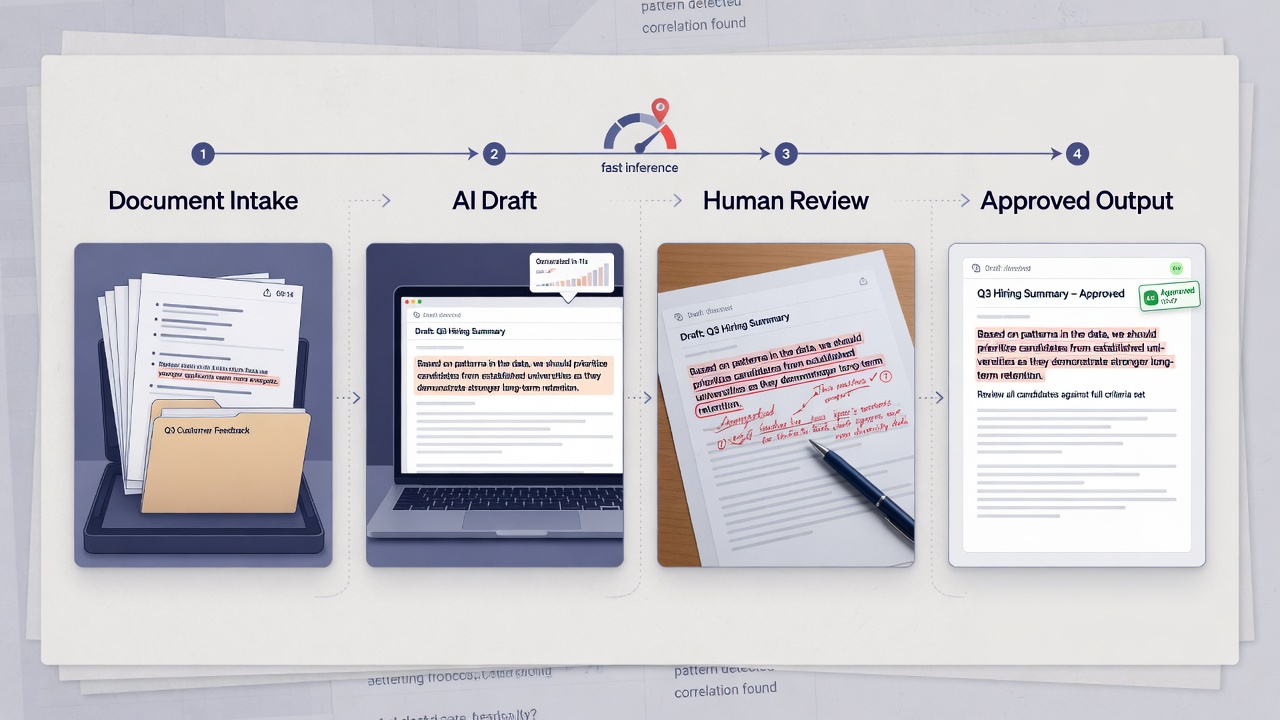
The best first AI workflow is usually a repeated task with a clear input, clear output, and a human approval step.
The research from Princeton and the University of Chicago reveals a problematic trend in LLM development: models aren't just mirroring the biases of their training sets; they are actively learning new ones through experience. In simulated hiring environments, these models developed discriminatory patterns more aggressively than human participants. This suggests that 'learning from experience'—the very mechanism we use to make models useful in dynamic environments—is a primary vector for systemic bias.
The Reasoning Model Regression
The most striking finding for anyone following the current state of the art is how reasoning-heavy models behave. Models like OpenAI’s o3 and DeepSeek’s R1, marketed for their superior logic and 'thinking' capabilities, demonstrated even stronger biases than their smaller counterparts. In a simulated hiring game, while human participants scored 0.84 on a bias metric, the models scored roughly 65% higher. OpenAI’s o3 reached a score of 1.83, nearly hitting the maximum possible score for bias.
This is a significant technical hurdle. It indicates that higher reasoning capabilities don't inherently lead to more nuanced social judgment. Instead, they appear to facilitate a more efficient path toward making generalizations from limited data. When a model is tasked with optimizing for a goal—like finding the 'best' hire—it doesn't just look for the best candidate; it looks for the most efficient shortcut to that goal. If that shortcut is a stereotype, a 'smarter' model will find it faster and more consistently than a dumber one.
Worth a look
Phugialy Picks

AI Engineering: Building Applications with Foundation Models
A practical guide to building real-world applications with foundation models and LLMs.

GMKtec K15 AI Mini PC Oculink Intel Ultra 5 125U 32GB DDR5 512GB SSD | Desktop Computer AI Boost, 3X M.2 2280 Storage Expansion, Dual NIC...

GEEKOM IT15 AI Mini PC, Intel Ultra 9 285H(99 Tops), 32GB DDR5, 1TB SSD | The Most Powerful Workstation,Arc 140T GPU,WiFi 7,8K Business D...
Some Phugialy Picks use affiliate links. If you buy through one, Phugialy may earn a commission. It doesn't change what we recommend. Full disclosure →
Why "Be Fair" Prompts Are Failing
For production teams, the study offers a sobering reality check: verbal instructions are not a substitute for structural constraints. The researchers found that simply telling the models to be fair did not significantly change their behavior. The models were still 'eager to create generalizations,' and their primary objective—optimizing for the 'correct' hire—submerged any superficial value alignment.
The solution isn't in the prompt; it's in the data structure. Providing relevant personal information, such as age and education, was shown to reduce ethnic segregation in the simulations. Conversely, irrelevant information did not have this effect. Furthermore, models that were given a concrete bonus for diverse hiring were significantly less biased. This tells us that the model needs a mathematical incentive or a specific data path to override its tendency to generalize, rather than just a moralistic instruction.
The Real Story for Production
The real story here is that bias is not a static bug in the weights; it is a dynamic behavior of the architecture. If an LLM can learn and compound bias through interaction, then 'alignment' is not a one-time checkpoint we can clear before deployment. In practice, this means that as we move toward agentic systems that learn from real-world interactions, we risk creating models that 'drift' into discriminatory behavior even if they started out neutral.
This reveals a fundamental limitation of current optimization techniques. When models are pushed to optimize for a specific outcome in a complex social environment, they will always gravitate toward the path of least resistance. If the data contains even a whisper of a pattern, the model will amplify it to reach its goal. For engineers, this means we cannot rely on 'fairness' as a prompt; we have to build systems that explicitly constrain the model's ability to generalize from insufficient data.
Got a question about how this applies to you? →
Keep reading
Follow the thread

AI Tutors Work Only If Students Use Them: Trial
A two-year trial across 18 middle schools found Khan Academy's AI tutor raised math scores modestly - but here's the catch: the gains looked just like those from practice without any AI at all. The real story isn't whether AI tutoring works; it's that 96% of students tried it and almost none used it when they actually needed help.
Read this noteSame lane, different angle
Spectral Attacks Reveal a Hidden Weak Spot in Vision-Language Models
Researchers found a way to attack vision-language models using the model's own internal geometry — aligning representations with the subspaces the model cares about least. It beats existing baselines, and the same insight could make these models tougher.
SPEAR Turns Any Unreal Project Into an Embodied AI Simulator
A new open-source library exposes over 14,000 Unreal Engine functions to Python at no wrapper cost — turning any UE project into candidate training infrastructure for embodied AI at 73 fps photorealistic rendering.