The Hidden Exfiltration Channel in Federated Learning
Federated learning (FL) is frequently pitched as the gold standard for privacy-preserving machine learning. The pitch is simple: keep data local, share only the gradients. But the FedCVESA research exposes a structural f
Automation needs a narrow first win
The best first AI workflow is usually a repeated task with a clear input, clear output, and a human approval step.
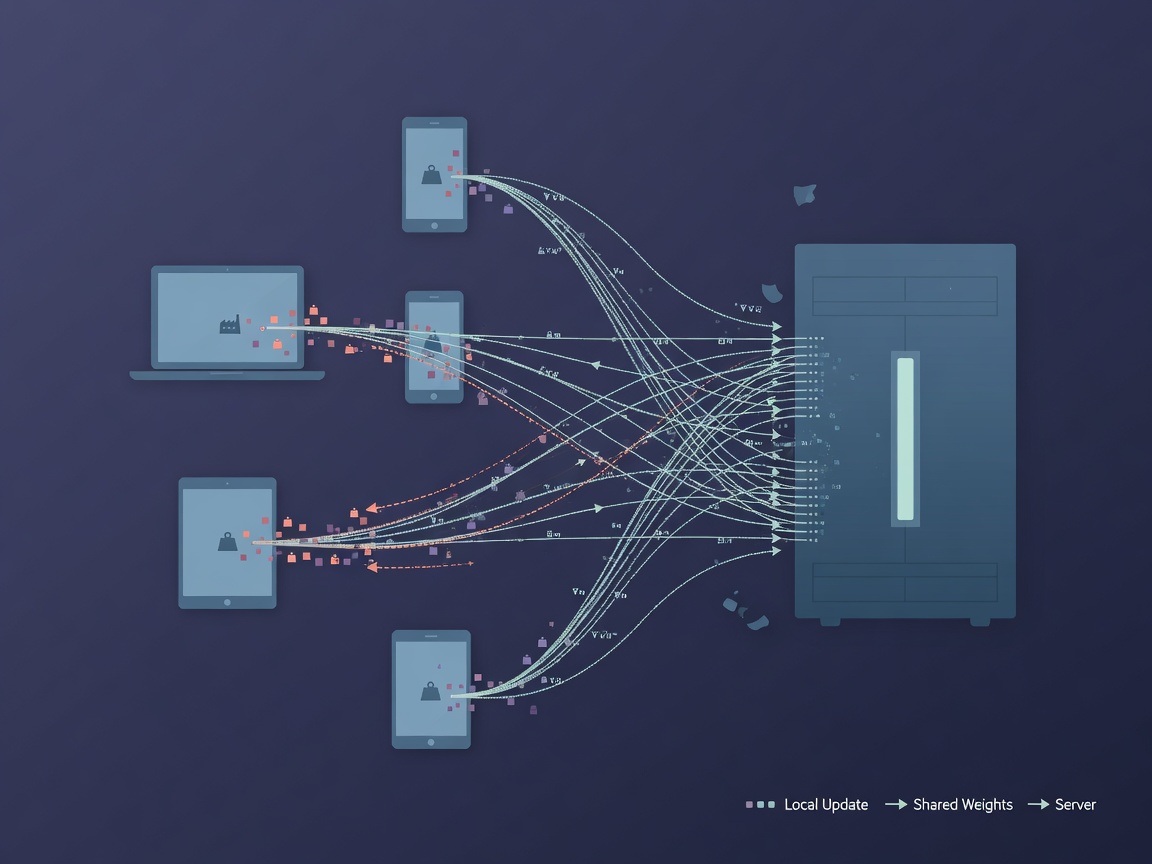
Federated learning (FL) is frequently pitched as the gold standard for privacy-preserving machine learning. The pitch is simple: keep data local, share only the gradients. But the FedCVESA research exposes a structural flaw that many practitioners overlook: model parameters can be weaponized as a covert channel for data theft. This isn't a passive leak; it's an active, intentional manipulation of the training process.
Weaponizing Weights via Parameter-Level Memorization
The FedCVESA attack turns model weights into a storage medium. Instead of just minimizing loss while generalizing, a malicious server uses a Pearson-correlation regularizer to encode specific private training data into "carrier parameters." This ensures the model doesn't just "accidentally" memorize data—it actively stores it in a way that can be retrieved later.
Worth a look
Phugialy Picks

GMKtec EVO-T2S Mini PC AI Ultra X7 Processor 358H 64GB LPDDR5X 8533 MT/S | Gaming Mini Computer Arc B390 1TB PCIe 5.0 SSD Oculink, WiFi 7...

AI Engineering: Building Applications with Foundation Models
A practical guide to building real-world applications with foundation models and LLMs.

OMOTON C2 Adjustable Aluminum Phone Stand
We'd buy this if: You want your phone upright on your desk for calls/notifications without a cable getting in the way.
We'd skip this if: You never keep your phone on your desk.
Some Phugialy Picks use affiliate links. If you buy through one, Phugialy may earn a commission. It doesn't change what we recommend. Full disclosure →
Hiding in Plain Sight: Segmented Aggregation
To keep the theft under the radar, the attack uses a segmented aggregation scheme. This allows the malicious actor to isolate the data of specific clients while ensuring the rest of the federated training process appears normal. By dispersing these carrier parameters across different segments, the server can systematically "take away" training data from targeted participants without triggering the usual alarms associated with massive, global data leaks.
The Utility Trap and the Trust Fallacy
What makes this particularly dangerous for production is the preservation of main-task utility. The researchers validated FedCVESA on standard datasets like MNIST, Fashion-MNIST, and CIFAR-10 using Dirichlet non-IID partitions—mimicking the messy, heterogeneous data environments we actually deal with in production. In these tests, the model continued to perform well on its intended task while simultaneously leaking private data.
For a practitioner, the takeaway is clear: a model that performs "well enough" is not a secure model. If a user sees high accuracy and low loss, they might assume the system is behaving correctly, while a malicious server is actually using those same gradients to reconstruct private inputs. The attack doesn't break the model's functionality; it hijacks its underlying mechanics to serve a secondary, malicious purpose.
The real story here is the assumption of the white-box trust model. In many federated architectures, the central server is the ultimate authority, trusted with the aggregation logic and the global model state. FedCVESA demonstrates that if that trust is misplaced, the very infrastructure designed to protect privacy becomes the primary vector for its destruction. It exposes a fundamental flaw in the "trusted aggregator" model: if you give the server the keys to the aggregation, you've also given it the keys to the data. We need to move past the idea that federated learning is a "set it and forget it" privacy solution. If the parameter-level memorization channel exists, then we must treat every model update as a potential leakage point. We need to start looking for ways to audit the weights themselves, not just the communication protocols.
Got a question about how this applies to you? →
Keep reading
Follow the thread

One-Shot Federated Learning and the Latent Space Trade-off
Federated learning (FL) is a production headache because of the communication overhead. If you're waiting for dozens of rounds to sync models across distributed clients, you're losing time and bandwidth. One-shot federat
Read this noteSame lane, different angle
One-Shot Federated Learning: Trading Weight Averaging for Synthetic Data
FedKT-CSD tries to solve the "one-shot" federated learning problem by using synthetic data instead of weight averaging. It's a clever way to keep communication low while maintaining formal privacy, but it shifts the burden of success onto the quality of the pretrained autoencoder.
AI Tutors Work Only If Students Use Them: Trial
A two-year trial across 18 middle schools found Khan Academy's AI tutor raised math scores modestly - but here's the catch: the gains looked just like those from practice without any AI at all. The real story isn't whether AI tutoring works; it's that 96% of students tried it and almost none used it when they actually needed help.